
Why is your AdSense RPM so low? Key factors for increasing revenue.
For example, on my tech review site, the average page dwell time is 3 minutes and 45 seconds, which means users have enough time to see multiple ads, so the RPM is naturally high.

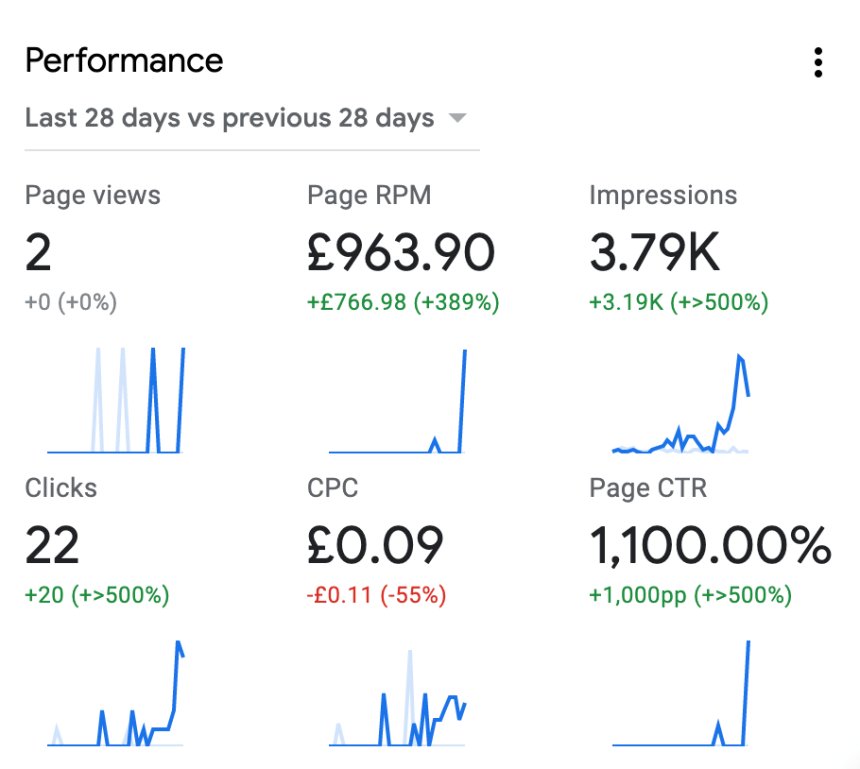
To be honest, I can relate to this issue very well. When I first started with AdSense in 2018, my RPM was also terrible, often hovering between $0.3 and $0.8. At that time, I really questioned my life and felt that this thing was a trap.
However, after six years of practical experience, the average RPM of my 12 main AdSense sites is now consistently between $6 and $8, with my best tech review site often reaching over $12. There are countless lessons learned from this, which I'll systematically share with you today.
Most people have a wrong understanding of RPM.
Before discussing improvement methods, I want to correct a common misconception. Many people believe that RPM is the cost per ad, and that more traffic means higher RPM, which is completely wrong.
RPM stands for Revenue Per Mille, which is revenue per thousand impressions. There are at least a dozen factors that affect RPM, and traffic is just one of them, and not the most important one.
I remember in 2019 there were two websites: one was my profile picture resource site, which only had 3,000 daily IPs but a revenue per minute (RPM) of $8; the other was a friend's entertainment news site, which had over 20,000 daily IPs but only $1.20 in RPM. Why was that?
The core reason is that users of profile picture material websites are designers and self-media practitioners with strong spending power, and they spend a lot of time on the page, so the ads are displayed fully; although entertainment information websites have a lot of traffic, their users are mainly students with limited spending power, and they browse very quickly, so the ads are not displayed fully.
Therefore, the first step to improving RPM is to understand its essence: user quality × page experience × ad optimization.
User quality determines the upper limit of RPM.
This is the most fundamental factor, and one that many people overlook. The difference in advertising value between different regions and different groups of people is enormous.
Regional differences
The website I currently operate primarily targets these regions:
-
United States: RPM is typically $8-15 -
Canada, UK, Australia: RPM is $5-10 -
Germany and France: RPM is $4-8 -
India and Brazil: RPM between $0.5 and $2
This difference is an objective reality, and it cannot be compensated for by optimizing technology. Therefore, in 2020, I decisively abandoned the Chinese market and fully shifted to the English market. This adjustment alone caused the RPM to rise from an average of $2 to $6.
User group differences
Even within the same region, the value of different user groups varies significantly. Based on data from the past few years, I've summarized a general ranking:
-
Corporate decision-makers and senior executives: RPM can reach over $20. -
Tech professionals and designers: RPM is $10-15 -
College students and white-collar workers: RPM is $3-8 -
High school students and retirees: RPM is $1-3
That's why I mainly create websites in vertical fields like technology reviews, design tools, and business analytics. Although the traffic isn't as high as entertainment sites, the RPM is much higher.
Keyword intent analysis
More meticulously, it's necessary to analyze users' search intent. Even when searching for "iPhone," the user value of "iPhone price" and "iPhone wallpaper" is completely different.
I now use Ahrefs to analyze the Commercial Intent Score of the main keywords for each website. The higher the score, the greater the advertising value. Generally speaking:
-
Purchase intent keywords (buy, price, review, vs): high value -
Information acquisition vocabulary (how to, what is, tutorial): Medium value -
Entertainment and leisure vocabulary (funny, free, wallpaper): low value
Page experience directly affects ad display.
Many people focus solely on content quality when building websites, neglecting the impact of user experience on RPM. In reality, a poor user experience directly leads to users leaving quickly, insufficient ad display, and consequently, low RPM.
Page load speed
This is the most basic and also the most important. I had a website before where, because the images weren't optimized, the page load time exceeded 5 seconds, the user bounce rate was as high as 70%, and the RPM was only $1.50.
Later I made a complete optimization:
-
All images compressed to under 100KB -
Use CDN acceleration (I'm currently using UPYUN). -
Enable browser caching -
Compress CSS and JS files
After optimization, the page load time was controlled within 2 seconds, the bounce rate dropped to 40%, and the RPM increased to $4.2.
Mobile adaptation
Currently, 70% of traffic comes from mobile devices. If your website doesn't provide a good user experience on mobile, your RPM will definitely not be high.
All my websites are now designed with mobile-first principles, and I pay special attention to these points:
-
The font size should be at least 14px; users should not have to zoom in to see it clearly. -
The spacing between buttons and links is large enough to avoid accidental clicks. -
The page width should be adaptive, and a horizontal scrollbar should not appear. -
Keep the navigation menu simple, with no more than 5 main categories.
Here's some data to refer to: My mobile RPM is usually 20-30% lower than the desktop RPM, but if the mobile experience is good, this gap can be reduced to less than 10%.
Content structure optimization
Many people overlook this point. The longer a user stays on a page, the more ads they see, and the higher their RPM will be.
I now use this structure when writing articles:
-
Start by highlighting a pain point or providing data to attract attention. -
Use subheadings to divide the text into paragraphs, each no more than 150 characters. -
Adding images and tables appropriately can enhance visual hierarchy. -
Leave the ending with a cliffhanger or pose a question, and encourage comments.
For example, on my tech review site, the average page dwell time is 3 minutes and 45 seconds, which means users have enough time to see multiple ads, so the RPM is naturally high.
The Art of Advertising Layout
The placement and number of ads have a huge impact on RPM, but most people's understanding is limited to "the more ads, the better," which is completely wrong.
The Golden Rule of Ad Placement
Based on my six years of testing experience, these are the ad placements that perform best:
-
Below the article title: This is where users' attention is most focused, and it gets the highest click-through rate. -
The middle of the article: a point of reading fatigue where users are easily distracted. -
Above the comments section: While users are thinking after reading the article -
Top sidebar: Looks good on desktop, but be cautious on mobile.
However, it's important to note that not every ad slot needs to be filled. My current standard is: a 1000-word article should have a maximum of 3 ad slots. Exceeding this will negatively impact the user experience and be counterproductive.
Advertising size selection
Many people overlook this detail, but it has a significant impact. I mainly use these sizes now:
-
336×280 (rectangle): Highest click-through rate -
728×90 (Banner): Suitable for the head and bottom. -
300×250 (medium rectangle): suitable for insertion within content -
160x600 (wide skyscraper): suitable for sidebars
The key is to choose based on the type of content. For example, on my image site, users mainly look at pictures, so I use large rectangular ads; on my technical blog, users mainly look at text, so I use banner ads.
The power of adaptive advertising
This is a new feature launched by Google that automatically adjusts ad size based on the user's device. I now use responsive ads for 70% of my ad placements, and the results are indeed much better than fixed sizes.
Here's some data: After switching all the ads on one of my design tool sites to responsive advertising, the RPM increased from $5.2 to $7.8, a 50% increase.
The underlying logic of content strategy
Many people think AdSense is just about creating a website, placing ads, and collecting money, completely ignoring the impact of content on RPM. In reality, the quality and type of content directly determine the value of an ad.
High-value content types
Based on my testing over the past few years, these types of content have the highest RPM:
-
Product evaluation and comparison: Strong user purchase intent, high advertising value. -
Technical tutorials and guides: High user engagement and long dwell time. -
Industry Analysis and Trends: Target Users Have Strong Spending Power -
Tool recommendations and usage: tools that easily generate conversions.
For example, on my tech review site, an article titled "iPhone 15 Pro vs Samsung Galaxy S24" can generate $15 in revenue per minute (RPM) because readers of that article are likely to make a purchase, and advertisers are willing to pay a high price.
Keyword density balance
Many people go to extremes in this regard, either completely ignoring SEO or excessively stuffing keywords. My current approach is:
-
Main keyword density should be controlled at 2-3%. -
Naturally integrate long-tail keywords -
Enrich semantics with synonyms and related words
The key is to keep it natural; don't sacrifice user experience for SEO. I have a principle: if an article doesn't flow smoothly, I'd rather give up some keywords.
Content update frequency
This also has a significant impact on RPM. Google favors active websites and will give them more ad display opportunities.
I now maintain this update frequency for each site:
-
Main site: 1-2 articles per day -
Niche sites: 3-4 articles per week -
Tools site: 2-3 in-depth articles per month
However, quality is crucial; it's better to update less frequently than to post low-quality content. I've seen too many websites penalized by Google due to poor content quality, resulting in their RPMs being halved.
Data analysis is the key.
Many people rely entirely on intuition when using AdSense and never look at the data, which is a huge misconception. I now analyze this data every day:
Key performance indicator monitoring
-
RPM Trends: Is it Growing Steadily? -
Click-through rate (CTR): The normal range is 1-3%. -
Page views: The average number of pages viewed per visitor. -
Bounce rate: Ideally below 60% -
Page dwell time: at least 1 minute
If a certain indicator is abnormal, I will immediately analyze the cause and adjust the strategy.
The Importance of A/B Testing
I now conduct A/B tests 1-2 times a month to test the impact of different ad placements, sizes, and content types on RPM.
For example, I recently tested whether to include ads at the beginning of articles or not. I found that ads increased the RPM by 15%, but reduced user dwell time by 20%. After considering all factors, I chose not to include ads because, in the long run, user experience is more important.
Common RPM killers
Based on my observations, these factors are most likely to lead to low RPM:
1. Unhealthy traffic sources
If your traffic primarily comes from social media or direct visits, your RPM will be lower. Search engine traffic typically has an RPM 3-5 times higher than social media traffic.
I now get 80% of my traffic from Google searches, and the RPM of this traffic is around $8.
2. Violation of Google policies
This is the easiest thing to overlook. If your content or ad layout violates Google's policies, ad display will be restricted, and the RPM will naturally be lower.
I've seen friends have their entire accounts restricted and their RPM drop from $5 to $0.50 because they placed ads on adult content pages.
3. Technical issues
Slow website loading, poor mobile experience, and ad code errors are all technical issues that can affect RPM.
I now use Google PageSpeed Insights every month to check website performance and make sure there are no technical issues.
My RPM Improvement Case Study
After all that theory, let's look at some real-world examples. I'll use the tech review site I've been running the longest as a case study for detailed analysis.
Basic data
-
Launch date: May 2018 -
Current daily IP: 8000-12000 -
Main keywords: mobile phone reviews, computer configurations, technology news -
Target users: Technology enthusiasts, consumers
Optimization process
2018 (Initial Stage)
-
Average RPM: $2.3 -
Main problems: Low content quality, short user dwell time. -
Improvement measures: Focus on in-depth reviews and increase video content.
2019 (Content Optimization)
-
Average RPM: $4.6 -
Key improvements: Establish content standards; each article must be at least 2000 words. -
Key breakthrough: Started creating product comparison articles, resulting in a significant improvement in RPM.
2020 (Technology Upgrade)
-
Average RPM: $6.8 -
Key improvements: Complete website reconstruction and mobile optimization. -
Key breakthrough: Page loading speed optimized from 5 seconds to 2 seconds
2021 (User Experience)
-
Average RPM: $8.2 -
Key improvements: Added interactive features and optimized ad layout. -
Key breakthrough: Average page dwell time increased from 2 minutes to 4 minutes
2022 (Data-Driven)
-
Average RPM: $9.5 -
Key improvements: Establishing a data analysis system for precise optimization. -
Key breakthrough: Finding the optimal ad placement through A/B testing
2023 (AI-enabled)
-
Average RPM: $10.8 -
Major Improvement: Optimize content production with AI to increase update frequency -
Key Breakthrough: Establish a content matrix and drive traffic between content sources
2024 (Maturity)
-
Average RPM: $12.1 -
Key features: Stable data, strong user engagement -
Future directions: Optimize voice search, expand video content
Key Experience Summary
-
Patience is key: RPM improvement is a long-term process, and it takes at least 6 months to see noticeable results. -
Prioritizing user experience: Sacrificing user experience to improve RPM in the short term will inevitably come at a cost in the long run. -
Data-driven decision-making: All optimizations must be based on data, not on intuition. -
Content quality is fundamental: no amount of technological optimization can replace high-quality content.
Some thoughts on the future of RPM
Frankly, AdSense's RPM may face some challenges in the future.
On the one hand, ad-blocking software is becoming increasingly popular, especially among younger users, which directly impacts ad visibility. On the other hand, platforms like TikTok and Instagram are diverting significant attention, leading to a decline in traffic to traditional websites.
However, I think there are still many opportunities. For example, voice search and AI search are becoming increasingly popular, and if you can plan ahead, there is still a lot of room for growth. I'm currently testing how to make website content more suitable for AI search, and the initial results are quite good.
Most importantly, it's essential to maintain a learning mindset. I now spend time every day studying Google's policy updates and following some international SEO blogs. Although it can be tiring at times, it's necessary.
In short, a low RPM is not predetermined; the key is to find the right approach. I've grown my portfolio from $2.30 in 2018 to $12 now. While I wouldn't call it a huge success, it at least proves that this path is viable.
If your RPM is still low, don't be discouraged. Keep optimizing using the methods I've shared, and I believe you'll see improvement. Of course, if you have any specific questions, feel free to leave a message on my Silicon Power AI WeChat official account to discuss them.
One last reminder: Always comply with AdSense regulations. Don't violate Google's policies for short-term gains. I've seen too many friends lose their accounts and suffer heavy losses because of greed. A steady, long-term approach is the right way.
Share
What's Your Reaction?
 Like
0
Like
0
 Dislike
0
Dislike
0
 Love
0
Love
0
 Funny
0
Funny
0
 Angry
0
Angry
0
 Sad
0
Sad
0
 Wow
0
Wow
0









![Citi Strata Elite Credit Card [Updated October 2025: 100k Sign-up Bonus]](https://ebaydiy.com/uploads/images/202601/img_w500_69610b6ca9be86-12427828.jpg)