

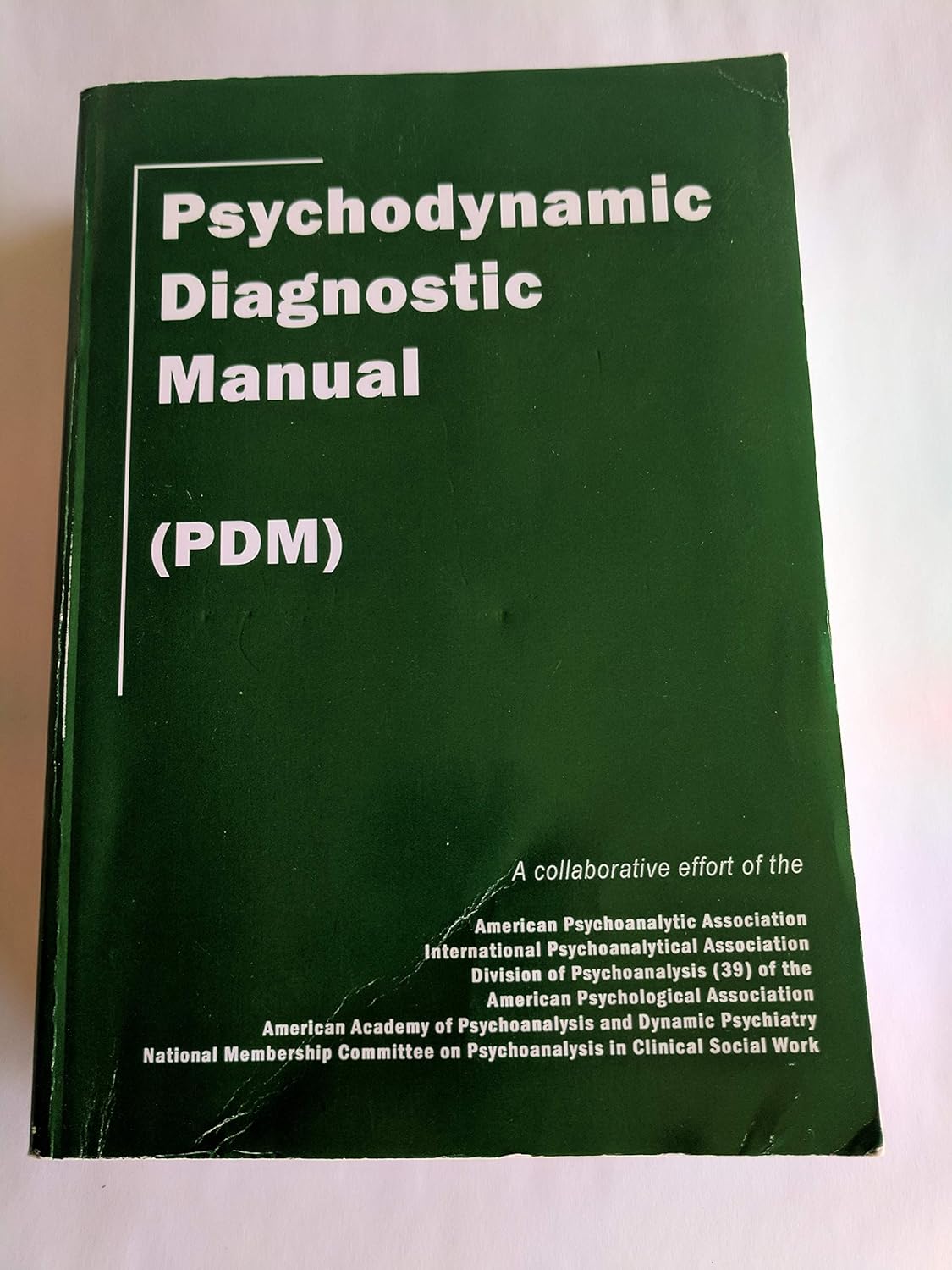
This manual is based on current neuroscience and treatment outcome studies that demonstrate the importance of focusing on the full range and depth of emotional and social functioning. Beginning with a classification of the spectrum of personality patterns and disorders found in individuals and then describing a profile of mental functioning that permits a clinician to look in detail at each of the patient’s capacities, the entries include a description of the patient’s symptoms with a focus on the patient’s internal experiences as well as surface behaviors. Intended to expand on the DSM (Diagnostic and Statistical Manual of Mental Disorders)and ICD (International Statistical Classification of Diseases and Related Health Problems) efforts in cataloging the symptoms and behaviors of mental health patients, this manual opens the door to a fuller understanding of the functioning of the mind, brain, and their development.
Publisher : Psychodynamic Diagnostic Manual
Publication date : May 28, 2006
Edition : 1st
Language : English
Print length : 600 pages
ISBN-10 : 0976775824
ISBN-13 : 978-0976775829
Item Weight : 4.02 pounds
Dimensions : 10 x 1.83 x 7 inches
Best Sellers Rank: #1,516,966 in Books (See Top 100 in Books) #1,803 in Medical Clinical Psychology #2,310 in Medical Professional Biographies #3,847 in Psychology (Books)
Customer Reviews: 4.5 4.5 out of 5 stars (120) var dpAcrHasRegisteredArcLinkClickAction; P.when(‘A’, ‘ready’).execute(function(A) { if (dpAcrHasRegisteredArcLinkClickAction !== true) { dpAcrHasRegisteredArcLinkClickAction = true; A.declarative( ‘acrLink-click-metrics’, ‘click’, { “allowLinkDefault”: true }, function (event) { if (window.ue) { ue.count(“acrLinkClickCount”, (ue.count(“acrLinkClickCount”) || 0) + 1); } } ); } }); P.when(‘A’, ‘cf’).execute(function(A) { A.declarative(‘acrStarsLink-click-metrics’, ‘click’, { “allowLinkDefault” : true }, function(event){ if(window.ue) { ue.count(“acrStarsLinkWithPopoverClickCount”, (ue.count(“acrStarsLinkWithPopoverClickCount”) || 0) + 1); } }); });

 2026 FOXWELL NT624 Elite OBD2 Scanner Upgraded from NT614Elite & NT604Elite Code Reader, All-System OBD2 Scan Tool, 8 Advanced Reset Functions, AutoVIN, Live Data, Lifetime WiFi Free Updates eBaydiy Tools
Original price was: $269.99.$219.99Current price is: $219.99.
2026 FOXWELL NT624 Elite OBD2 Scanner Upgraded from NT614Elite & NT604Elite Code Reader, All-System OBD2 Scan Tool, 8 Advanced Reset Functions, AutoVIN, Live Data, Lifetime WiFi Free Updates eBaydiy Tools
Original price was: $269.99.$219.99Current price is: $219.99.
 YamahaMarine Y.D.S. Marine Diagnostic Kit for Outboard Engines & PWC - Compatible with EFI 4-Stroke & HPDI Models, Includes Hardware, Software eBaydiy Tools
$285.00
YamahaMarine Y.D.S. Marine Diagnostic Kit for Outboard Engines & PWC - Compatible with EFI 4-Stroke & HPDI Models, Includes Hardware, Software eBaydiy Tools
$285.00
Psychodynamic Diagnostic Manual: (PDM) eBaydiy Tools
$40.96
🚚 Free Shipping on orders over $75+
📦 Arrives: Mar 21 - Mar 23
🛡️ 2-Year Professional Warranty Included
Guaranteed Safe & Secure Checkout

Peter B. Dunn MD –
A Diagnostic Manual With Categories Into Which People Actually Fit
Finally the psychoanalytic world has produced a diagnostic manual that describes people in a way that is true to life since it incorporates symptoms, inner experiences and the person’s strengths and weaknesses. This book at long last puts into black and white the diagnostic map that analysts have used for the past 30 years, though never as an authorized nosology. The result of the long delay is the sad truth that the DSM has had no competition. Wisely the authors–essentially everyone in field of note who has been interested in questions of diagnosis including Kernberg, Wallerstein, McWilliams and Drew Westen — present the PDM as complementary to the DSM rather than as a replacement since the DSM is unfortunately too firmly entrenched to be dislodged. However the PDM really boils down to an alternative diagnostic system, which corrects the over-simplifications, some of the omissions and a lot of the implicit biological bias of the DSM. In the correcting-omissions-department the PDM restores some traditional personality types that are very common in office practice – like depressive and masochistic – that were left out of the DSM because politically important factions lobbied against their inclusion. The PDM also has restored ‘borderline’ to its more usual usage as a level of severity. Still, there are suprises in the PDM. Three new “personality types” are introduced, and without full explanation why. These are the the anxious, the dissociative and the somatizing personalities. Usually anxiety, somatization and dissociation are included as symptoms (which the PDM does as well) but here these pathologies are listed as defining personality types. Since no research data is presented to support these additions, the impression is left that one or more members of the Committee prevailed and had to be assuaged in order to hammer out the final compromise document. But what will be most suprising to people who buy this book — expecting a diagnostic manual — is that about half of this 800 page book is not a manual at all but a collection of supportive research articles that are not specifically explications of the PDM’s diagnostic system. The articles amount to a high level conversation between the analytic researchers and the makers of the DSM, particularly the Axis II committee. It remains to be seen if the audience for this kind of manual – clinicians overwhelmingly – will be put off by so much of the book being devoted to learned articles not obviously related to “The Manual.” I myself would have preferred that these pages had been devoted to a fuller explication of the diagnostic system of the PDM (sometimes described too briefly) and with more case examples, since that would help ensure that different readers apply the criteria in the same way (i.e. the reliability issue). Nonetheless the PDM towers over the DSM and no quibble about shortcomings should obscure that fact. The overall schema is more true to life and more clinically on target and the personality types are better described and in fewer words than those of the DSM. Unlike the DSM you won’t need a tool kit from Home Depot to fit someone into a diagnostic category.
moshe benollon –
Great condition
It is the first edition but very useful for me as a clinician. Thanks
Claude Ouellette, PhD –
Just my thoughts …
While I have read about 1/3 of the book to date, it is written in a layperson form making it simple to understand concepts as proposed in research-based studies. I have a particular interest in how symptoms come about in individuals … from a qualitative subjective experience to how symptoms can help predict mental health disorders. I particularly like PDM conceptualization of symptom formation and believe I will enjoy the section on child and adolescent development, including how symptoms may present at these ages. A quick look at the references shows a good balance between well cited research studies and the more contemporary studies in psychoanalysis. While PDM is a good diagnostic manual to have in one’s library I did wonder how it can or would impact future DSM formulations.
Robbie Jay –
Diagnosis that Actually Means Something
If you’ve come to this page, it’s probably because you are a psychodynamic thinker interested in what others are saying about this book. So, if you haven’t bought it yet, I highly recommend that you get it. Hide the DSM somewhere and only pull it out when some insurance company forces you to. The PDM is the book to use if you’re actually interested in understanding diagnoses based on something that makes sense.Now, if on the off chance you’ve come to this page not knowing what the PDM is all about: first, look at the price compared to the DSM. The DSM attempts to rob of us of $80, the PDM is meant to be affordable at under $25. Unlike the most recent version of the DSM and it’s many meaningless revisions, the PDM is not a ploy to make money. So go out and buy 3 PDMs, give 2 of them to your friends and know that you still saved about $20 compared to buying just 1 copy of the DSM.What is the PDM? It is a contribution from the best of the Psychodynamic thinkers giving us the opportunity to understand what meaningful diagnoses are about. The PDM stands alone. My only complaint is the soft and tentative tone it takes in relation to the DSM — the PDM authors suggest that it is a supplement to the PDM. It is a supplement to the PDM in the same way that oil is a supplement to water. The DSM and the PDM do not go together in any way shape or form, and it is unfortunate that the PDM authors chose to compromise in this regards. Other than that, the book is nearly flawless.If the mental health profession was operated by psychologists, social workers, and the small collection of psychiatrists that aren’t interested in pharmaceutical dirty money (rather than managed care companies along with the deceitful pharmaceutical companies and their psychiatry pawns), this book would be the Queen. Maybe someday.
Paul V. KATCHALOV –
A Great Work In The Defense Of The Psychoanalytical Cause In Psychiatry of Worldwide Importance.
The book is a fruit of an immense work done by many teams of psychoanalysts and psychodynamically minded clinicians in the USA, where the problem of co-existence of psychoanalysis as a recognized clinical practice with its therapeutic efficacy, with the psychiatric (crypto-behaviourist in its theory and pharmacologically oriented in its practice) DSM classification of mental disorders, was born and tense as nowhere else. The psychoanalysts of the entire world should be thankful for their American colleagues for their titanic struggle for the case of psychoanalysis in psychiatry. The American psychoanalysts opted to do not ignore the Zeitgeist — id est, the growing implication of the third parties (governmental administrations and insurance companies) in the therapeutic process. The book contains the results of thorough reading of the DSM texts, and sensible additions and corrections that the psychoanalytical vistas may introduce in what must be seen as a permanent work in progress, and not at all a trap of pseudo-divine Revelation, as it too often happens to turn in the hands of too many affordability-only minded “third parties”.
Mr. Adam West –
This text makes for intriguing reading. It presents a convincing alternative to a categorical approach to PD. The presentation has both intellectual rigor and clinical utility.
N. D. Graham –
I got the Kindle version for my smartphone and pen pc which I use in my sessions at the office as well as at home on my desktop pc to write reports and update files. It is so convenient and just as easy to use as the paper version once you get the hang of Kindle. Extremely well produced as clear as the original hard copy but so much more portable. Great price, too!
Tacheles –
In Deutschland scheinbar kaum genutzt, zum Verständnis von z.B. Manualen von Kernberg sehr nützlich. Alternatives eher dimensionales denn kategoriales System in dem vielfach in den neuen Auflagen von ICD und DSM nicht genutzte Persönlichkeitsstörungen abgebildet werden, z.B. Depression, Angst ode Somatisierung unter dem Aspekt einer Persönlichkeitsstörung ohne die gleichen Störungen aus der “Achse-I” zu entfernen.
セーヌのほとりで –
好むと好まざるとに関わらず、DSMやICDの操作的診断基準しか手渡されていないので、いつの間にか操作的認知形式にマインドコントロールされてしまっていた。しかし佛教大学の岡本重慶教授が日本に始めて紹介したフランス精神分析的心身医学から生まれたMarty心身相関診断基準が唯一、精神力動的な基準を提供していたので、小生も準拠しいくつかの症例報告を続けてきていた。しかし残念ながら日本の臨床において一般化には至らなかった。今回米国精神分析協会、国際精神分析協会、米国心理学会、米国精神分析的力動的精神医学会、米国臨床社会福祉精神分析協議会の連名で、DSMやICDを補完する血の通ったPDM診断基準が公表された。P軸は人格傾向と障害、M軸は精神機能水準、S軸は主観的症候であり、児童思春期でもそれぞれPCA軸、MCA軸、SCA軸がある。今後Marty基準と同一症例で比較検討してみなければならないと考えている。その後ほとんどコードを棄却し、常識的である意味薄っぺらくなったPDM-2に改訂されるのだが、初版の価値は極めて大きく、手に入らなくなる前に、入手しておく必要がある資料書であることは確かであると考える。残念なPDM-2より断然お勧め。
Amazon Customer –
useful tool in the comprehensive formulation of symptoms including history and development path.Better understanding of the treatment of psychopathology.